
Contractual Value Architecture (CVA)
Align revenue, contracts, and delivery so execution delivers what was sold.
Most IT service contracts don’t fail on paper. They fail in execution. CVA closes that gap.
Why Most IT Service Contracts Fail to Deliver Value
Most IT service models are built in silos, with each function optimizing for its own objectives rather than for overall value creation and execution coherence.
The problem is not individual failure. It is systemic misalignment across the value chain.
Root causes
- Sales optimizes for deal closure, not customer value
- Contracts focus on risk coverage, not field reality
- Delivery teams are left to adapt to execution reality
- Governance is weak and too often reduced to escalations
What follows
- SLA dashboards stay green, but value is not delivered
- Margins never fully materialize despite “profitable” deals
- Escalations become the new operating norm
- Clients and suppliers do not share the same definition of success
The result is not operational inefficiency. It is structural misalignment.
Contracts are not failing legally. They are failing systemically.

What is Contractual Value Architecture (CVA)?
Contractual Value Architecture (CVA) is a framework that aligns commercial intent, contractual design, operational delivery, and governance into a coherent system.
It starts where most misalignment originates: in sales.
It connects pricing logic, SLA and SLO structures, governance mechanisms, and delivery models into a single coherent system.
Sales is not just an input to the system. It is where alignment, or misalignment, starts.
Its purpose is not compliance. Its purpose is coherence.
The CVA Framework
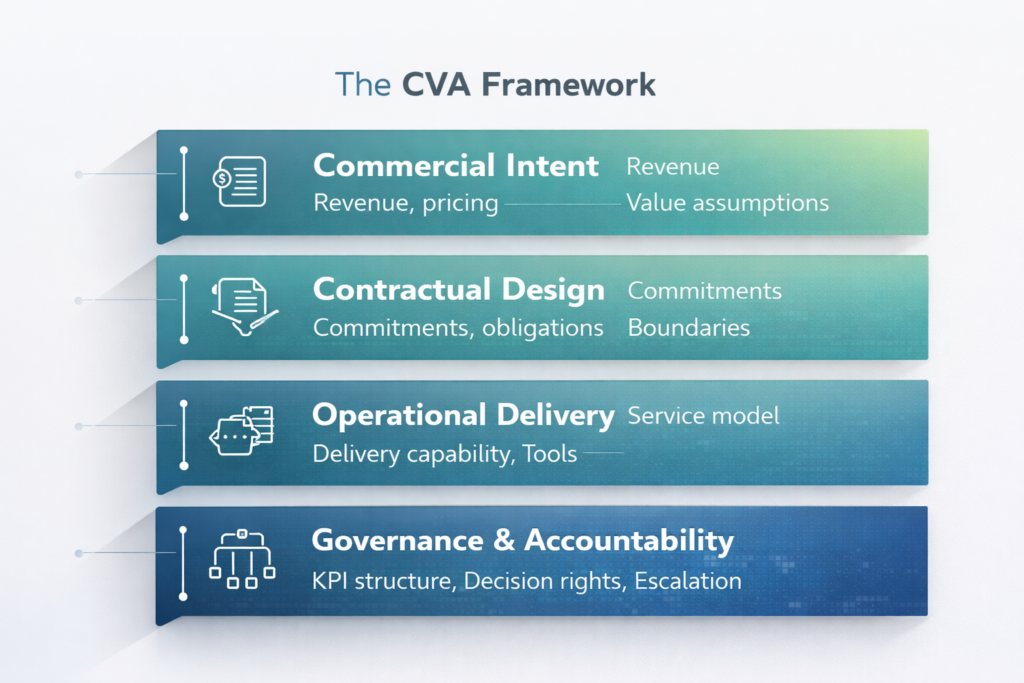
CVA structures service execution across four interdependent layers. Weakness in any one layer is typically absorbed by another, often at the expense of value, accountability, or margin.
1. Commercial Intent
This layer defines the economic logic of the deal: what is being sold, why it matters, how it is priced, and which value assumptions support it.
- Revenue model
- Pricing logic
- Deal assumptions
- Value hypothesis
If this layer is weak, everything downstream compensates.
2. Contractual Design
This layer translates commercial intent into commitments, obligations, limits, and performance structures that can actually be governed.
- SLA and SLO definition
- Scope boundaries
- Risk allocation
- Incentive mechanisms
Most contracts describe obligations. Few are designed to support outcomes.
3. Operational Delivery
This layer is where promises face execution reality. It includes the operating model, delivery capability, tooling, and the real conditions required to perform consistently.
- Service model
- Tools and processes
- Resource model
- Execution capability
Delivery is where misalignment becomes visible.
4. Governance & Accountability
This layer ensures performance is monitored, understood, and corrected through decision rights, escalation paths, and value-linked accountability mechanisms.
- KPI structure linked to value
- Decision rights
- Escalation logic
- Performance reviews
Governance should drive correction, not just reporting.
What CVA Changes in Practice
CVA does not optimize contracts in isolation. It improves the conditions under which service execution creates value, preserves margin, and sustains trust over time.
- Reduced margin leakage
- Cleaner and faster deal execution
- Fewer escalations and fewer avoidable disputes
- Clearer accountability across stakeholders
- Stronger client trust and more resilient partnering relationships
- Better renewal conditions through more credible delivery performance
CVA does not improve paperwork. It improves the practical conditions under which service execution creates value, preserves margin, and sustains trust over time.
Where CVA Applies
CVA is not limited to a specific type of service model. It applies wherever value depends on the alignment between what is sold, what is contracted, and what is delivered.
Managed services transformation
Align pricing, SLA structures, and delivery capability during large-scale service transitions
XaaS and subscription-based service models
Ensure recurring revenue models remain aligned with delivery performance and cost structures
Complex outsourcing agreements
Reduce execution gaps in multi-year, high-dependency contractual environments
Multi-vendor service environments
Align responsibilities, interfaces, and accountability across multiple providers
AI-enabled service delivery models
Ensure automation and AI integration remain aligned with contractual and operational realities
Service portfolio restructuring and rationalization
Align portfolio design, pricing logic, and delivery capability
Any environment where misalignment between sales, contracts, and delivery impacts value realization
CVA is not limited to a category of services. It applies wherever value depends on alignment across sales, contracts, and delivery.
Do You Have a CVA Problem?
Most organizations do not identify misalignment at design stage. It becomes visible only when delivery friction, margin erosion, or repeated escalations start to accumulate.
If several of the below questions resonate, the issue is not isolated. It is structural.
- Are your SLAs disconnected from pricing logic?
- Do delivery teams regularly reinterpret what was sold?
- Are governance meetings focused on issues rather than outcomes?
- Do contracts require frequent clarification or renegotiation?
- Is margin erosion visible after deal signature?
- Do clients and internal teams operate with different definitions of success?

Run your CVA Diagnostic
Identify where execution gaps are already impacting your contracts, delivery performance, and margin.
⇢ Takes less than 10 minutes
For operational leaders and account teams
Contractual Value Architecture (CVA) has been exposed first by Paul Neuman, Founder of IT Services Demystified.